Electronics
Electronics from the ground up, built the way I wish it had been taught to me: draw the circuit, watch the numbers move, and read the chapter that explains why. Every tool has a verified solver and a textbook of its own.
Formula index Every formula from every one of these tools in one searchable place — with its units, where it comes from, and a link that opens it in the calculator. Search the formulas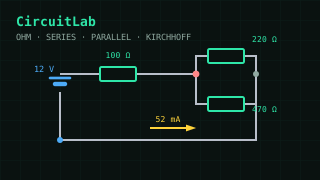
CircuitLab — DC Circuit Basics
CircuitLab — click a circuit together on a grid and watch it solve itself: node voltages coloured by potential, a current arrow on every component pointing the way it really flows, and bulbs that light up as hard as they are driven. Batteries with internal resistance, current sources, switches you can open to see what stops. Behind it is real nodal analysis, so a Wheatstone bridge works as readily as a series chain — and the tool says so when series/parallel reduction gives up. With a twelve-chapter textbook from charge and current through Ohm's law, series, parallel, Kirchhoff, dividers, power and the real source.
Open project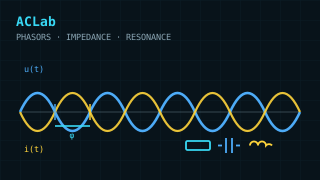
ACLab — Alternating Current
ACLab — the same board, one new number: frequency. Draw a circuit with coils and capacitors in it, turn the frequency knob and watch everything move at once — an oscilloscope showing voltage and current drifting out of step, a phasor diagram where the component voltages add tip to tail, and a swept frequency response that finds a resonance by looking rather than by quoting a formula. Behind it is nodal analysis in complex arithmetic, checked against a Runge–Kutta integration of the actual differential equation. With a twelve-chapter textbook from where a sine comes from, through RMS, phasors, reactance, impedance, resonance and power factor, to filters and the grid.
Open project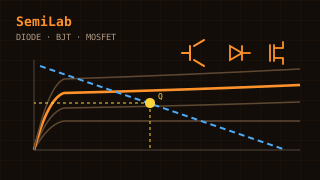
SemiLab — Semiconductors and Transistors
SemiLab — where the straight lines end. A resistor is a number; a transistor is a surface, and what it does depends on where on that surface it sits. So this card draws the one picture that genuinely explains it: the device's own characteristic curves with the circuit's load line laid across them, and the operating point sitting where they cross. Pick a circuit — diode, LED, Zener regulator, switch, amplifier, follower, current mirror, MOSFET, CMOS inverter — change any value and watch the point move, the gain change and the output clip because the transistor really ran out of room. Behind it is Newton-Raphson on nodal analysis, the same method every circuit simulator uses, checked against a load line solved by bisection. With a thirteen-chapter textbook from the silicon lattice to the heatsink.
Open project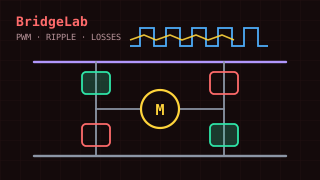
BridgeLab — Motor Drive Electronics
BridgeLab — the motor is chosen; now what do you switch it with. Four transistors around a motor, and every question that follows: how a duty cycle becomes a speed, why the current ripples and which of the three modulation schemes ripples least, where the watts go between conduction and switching, and what dead time quietly steals. Pull the duty below the motor's back-EMF and watch the current reverse on its own — the bridge regenerates without a single extra part, and the tool tells you whether the bus capacitor can take it. The ripple is computed three independent ways that agree to six figures. With a thirteen-chapter textbook from PWM to the brake resistor.
Open project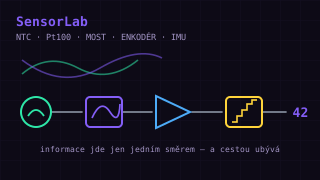
SensorLab — Sensing
SensorLab — every other card starts from a circuit; this one starts from the world. A temperature, a force, a position, a distance — and the long road by which each becomes a number. Thermistors and Pt100s, thermocouples and the cold junction everybody forgets, strain gauges and why a Wheatstone bridge can read 0.7 Ω out of 350, encoders and the quadrature that gives direction away for free, Hall sensors, ultrasound and the temperature it does not know about, and an IMU whose gyro drifts and whose accelerometer cannot tell gravity from motion. Pick a sensor, set your amplifier and converter, and the tool names which link limits the answer — then add bits and watch them not help. With a thirteen-chapter textbook, one per sensor family.
Open projectWhat is next. These two cards are the foundation. Transients come next — charging, time constants, what happens in the first milliseconds — then semiconductors and amplifiers, each as its own card beside these.